
Rethinking Success: Maybe you don't want to design buildings
Pathways beyond the blueprint

I want you to imagine a completely different version of success for yourself — for the life you want to live, your career path, and how you view architecture as a whole. I want you to see success through a different lens.
You might've grown up hearing people ask, "What do you want to become when you grow up?" So somehow you chose architecture — and now, perhaps, you want to become a ‘successful architect’. But what does that mean?
What usually comes to mind when thinking about becoming a successful architect is designing buildings that get featured in magazine covers, curating a portfolio that gleams with prestige, creating marvels admired by global audiences, being able to earn good money when the majority doesn’t. Maybe it looks like sitting on the right panels, collecting the right titles and certificates, working at the firms that open the right doors. It could even look like advancing all the right things — zero carbon, passive house, renewables, recycled materials, you name it. Ticking all the progressive boxes.
But beneath it all, can you feel it?
The weight. The pressure to build a career, more than a life. The unspoken rules of academia and practice that shape what success should look like. Ambition that, perhaps, hides something underneath… a tenderness… an innocence… a passion project.
But in a cut-throat profession like architecture often is — there is no space for that.
Consider this: you are full of deep, wild, boundless creativity. Gifts. Strengths. Interests. Curiosities. Desires. Values. Full of creativity that’s aching to be expressed and channeled into something you truly care about.
But the structure of education and most practices doesn’t really make space for that. How can it? The strategies are predefined. The goals are set. The timelines are rigid. The budgets are fixed. And so you end up expressing just a fraction of what’s inside you — often the same habitual expressions, recycled over and over again.
There are many great firms out there, but even they — do they satisfy your deep longing for impact? Do they match your version of success?
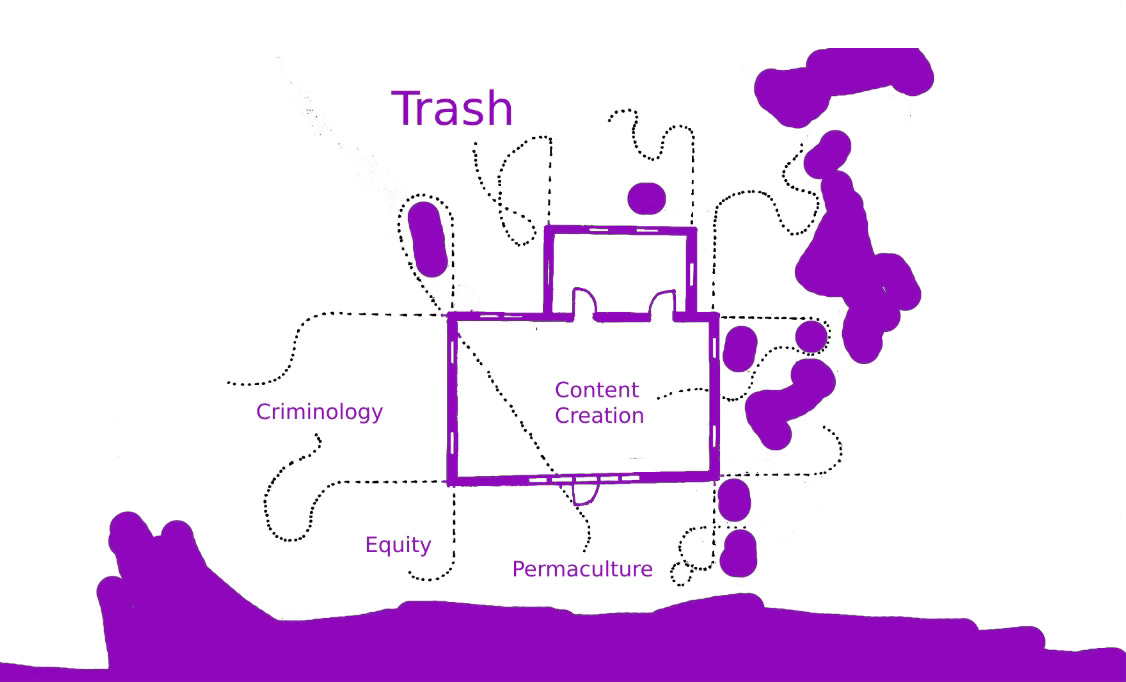
What does success look like for you?
Perhaps it's not the glossy magazine feature or the prestigious award. Maybe it's designing and stewarding community gardens that becomes a neighborhood gathering spot. Or creating a replicable model for a small, sustainable, affordable home that adapts to its inhabitants' needs. Maybe it's launching a design podcast that inspires students, or developing building materials with indigenous elders. Success could be teaching architecture in a way that nurtures expansive creativity rather than conformity. Or even walking away from traditional practice to become an advocate and designer for housing equity.
This kind of success feels and looks different than the omnipresent kind of success that puts outcome over process, that is always a race towards a destination.
Economic growth. Project completion. The next thing.
The thing is designed so it can be built.
It doesn’t matter how the job gets done, as long as it gets done. Did everyone pull all-nighters, unpaid? Were workers along the supply chain exploited? Was the client a nightmare? Were cheap methods and materials used that cost the planet? All that is not counted.
If the building gets built and the margins were good — it’s called a success.
Let’s not diminish money. Money is important, and we don’t want to deny that. But is it everything? Is money worth giving up your integrity, your deeper passions, your truer life?
Is it actually success if the process leaves you depleted? If it disconnects you and others’ from well-being? And do you feel you must design in order to build because you studied architecture — that if you don’t, you’re somehow less successful, less valid, less needed?
Why must success come at the cost of joy, care and integrity?
Certain measures of success sit very deep in our culture — and sometimes they have very little to do with our own.
Question any of it and you’re likely told that this is ‘just the way things are’
That if you study architecture, you design buildings.
That if you enter the profession, you compromise.
That in order to become successful, you follow the formula.
That the relentless pressure is simply the nature of the field.
That constraint limits creativity.
I beg to differ.
Did you know that structure is a constraint that, if applied in a healthy way, can liberate?
Structure can liberate.
I didn’t think those words would ever come out my mouth, but here I am, learning to befriend structure and see how, weirdly and paradoxically, structure can amplify creativity. I’ve totally discovered that during my book writing journey.
At first, each chapter contained a wild tangle of ideas and thoughts that were floating around without clarity. Completely overwhelming. Then I created a structure that felt clear and expansive, and suddenly the ideas had an anchor. Very intuitively, almost by themselves, they now land exactly where they need to be. Like a wild plant climbing up a supporting framework — not trapped by it, no, on the contrary — held, guided, directed. Once the structure was in place, each chapter just flowed so much more. And instead of feeling overwhelmed, the process became fun!
The same applies to my days. Once I found a daily structure that worked for me — for my rhythm, for my nervous system, for my energy, for my nature, everything flowed more easily. A structure that feels free and intuitive yet guiding and direction-giving. Never too rigid.
Mind you, this balance is still a process for me. The word ‘structure’ still has some difficult connotations for me. The younger me equates it with restriction, control and even punishment. So for a long time, the adult me swung to the opposite extreme: just flow. Only now am I becoming fully aware of this pattern. For me, it’s therefore very important to build structures in my life — for the book, for my platform and business, for my daily rhythm — but structures that feel supportive without being overly rigid. Just enough to give my flow a clear direction. I am slowly learning: structure doesn’t limit me. If applied in a healthy way, it frees me and my work. It allows me to feel and be successful, on my own terms.


What is your relationship with structure? Are you someone who loves to flow too, or are you more on the rigid side? How have you integrated both sides into your life?
I am asking because structure is important for you too. But keep in mind, too much structure can also be a coping mechanism. You need a kind of structure that works for your nature, your rhythms, your passions, your idea of life — not against it.
A structure that allows you to integrate your strengths, interests and values into one lifetime, one project, one business model.
Maybe you work better with a more rigid calendar, maybe you too like to flow a little more. Either way, try sitting still and just being, for a little while, and see how that feels.
A bit uncomfortable?
We can all benefit from making some space where we allow ourselves to simply relax and tune in. Because in those moments, when we slow down, the deep insights can come to the surface.
What is not aligned? Where are we chasing something that is not necessarily ours? Do we really want to work for that architecture firm, or does it simply look good on the resume? What are the passions and interests we can’t compromise in this lifetime? What kind of impact would we like to create?
Remember when I said you’re full of gifts? I meant that. Your creativity needs an outlet.
If you are interested in many things — architecture, social justice, criminology, permaculture, children, economy, textile design — there is a structure for that.
If you don’t want to go down that traditional route but upcycle and refurbish old planes — there is a structure for that.
If you want to improve the processes and environments in which babies are birthed — there is a structure for that.
If you want to quit your position as an architectural designer and become an online content creator who educates and enlightens crowds — there is a structure for that.
What do I mean by structure?
There is a container, a vehicle, a business, a lifestyle that can support all of you.
It is waiting to be found, shaped, or built by you.
A structure that connects your strengths, your interests, your way of seeing — and allows you to flourish and create the impact you seek.
A life that successfully supports your expression, not suppresses it.
For a moment, let’s reimagine success together — as not purely outcome-focused but deeply process-focused.
A building that doesn't put the shiny object first, but puts the inhabitants who live in it first. That engages and includes them in its process of making. That is not designed for shallow looks, but gets its good looks from being a living expression of life.
A design practice that has an extremely tight-knit, inclusive work culture. Where employees work forwards a common purpose together. Where conflict is resolved productively though vulnerability and openness. Where successes and failures are celebrated together.
A business that that puts your transformation first, that prioritizes your joyful process of creation. That is built on you sharing your story, insights and hard-earned knowledge and wisdom. That nourishes you from the inside out. That pays you well and becomes your vehicle for impact in the world.
Maybe you don't actually want to design buildings. Have you thought about that?
We're trained to see architecture as the making of buildings, as designing physical structures, but maybe it's not that at all. Maybe that can be a by-product if the process leads us there.
If you look at buildings, they're underpinned by numerous processes — policies, building codes, regulations, design decisions, material choices, stakeholder engagement.
So rather than seeing a physical object as the beginning and end of what you need to produce as an architectural graduate, consider that this notion might actually be stifling your creative expression and potential much more than you think. It might be holding you back from many other wonderful and impactful avenues of creation and possibility.
Many buildings that are cherished worldwide — the ones you look at and think, “Wow, they are such a success” — might make you believe that's the definition of success you should pursue. But what if we delve deeper into the process of making these marvels?
Maybe what we'd see isn't so much the shiny stuff but the very un-shiny stuff: the potential sufferings, environmental harm, displacement, habitat destruction that occurred in this process. Maybe opportunities for genuine transformation with surrounding communities and neighborhoods were lost in the pursuit of a version of success that looks shiny but is quite fragile when we dig deeper.
So what does success look like for you? What version of success would you like to pursue?
I don't even want to say 'what successful architect or architecture professional do you want to become’ because maybe you don't want to design physical buildings, and that’s perfectly fine. Sometimes we need to hear from someone else that we don't actually have to become an architect even if we study architecture. That there are many paths, and that’s simply one.
When you dig deeper, beneath the noise, beneath the fear, you’ll find a deeper truth there — the kind of truth that clears the fog and makes you see more clearly: what you feel called towards, where it is you need to go next, how you can go about it.
That’s really the essence of it. Going beneath the noise. Digging deeper than the standard version of success that we're indoctrinated with by society, architecture school, the profession. By family — that’s a big one — but perhaps subject for another exploration.
What is it that you'd really like to do?
Buildings? Ok cool, but what part of it? Building physics? Earthquake resilience? The psychology of space and and how it affects human behavior? Adaptive reuse? Biomimetic design? Light? Creating inclusive spaces for neurodivergent users? Community engagement? Regenerative processes and cultures? Participatory design? Conflict resolution between stakeholders? Photography? Exhibitions that challenge perception? Interventions that touch hearts? Educational games? Courses and workshops? Consultancy? Film? Apps? Knowledge sharing?

That pain of adhering to other people’s success, I know it too well. It doesn’t always feel like pain in the midst of it — but retrospectively I see it is painful because something has to suffer along the way. Meaning. Passion. Connection. Peace. Creativity. Purpose. Potential. Fun. Yes, fun.
Architecture can express itself in so many different ways, so why stick to one?
Consider Bruce Campbell, who transformed a Boeing 727 aircraft into his home in the Oregon forest. Is he an architect? An engineer? An interior designer? A visionary? An eccentric? Does it matter what we call him when he's living in alignment with his unique vision of home and space?

Did you know that a ridiculous amount of commercial aircrafts are retired and decommissioned every year? Aircraft graveyards in places like Asia and the USA house thousands of abandoned plane shells — each one a potential home, community center, creative studio, or classroom.
Imagine all there can be done with the trash in the world! Shipping containers, decommissioned trains, industrial waste — all of it could help alleviate housing crises, create emergency shelters, serve as clinics in remote areas, become outdoor classrooms. So much wealth of untapped opportunity!
When I share examples like this with people, I see a spark light up in their eyes — What if? What if I followed my own definition of success, no matter how unconventional?
So I ask you: What if you followed your own definition of success, no matter how unconventional?
This is the work that lights me up — guiding fellow architecture graduates, designers and creatives out of the same constraints I once knew to discover their unique potential and path. Right now, my days are filled with writing a book — a guide for inner and outer regeneration. I’m also opening space for collaborations, speaking engagements and workshop opportunities, with creatives as well as universities.
If you’re connected to a student group, a design department, or an institution that might be open to a guest lecture or workshop on reimagining architecture, I’d love to hear from you!
You can reach me directly or find more about my work here: www.architectureisnotabox.com
Let’s redefine success. Let’s get expressive and creative. Let’s rewild the field. Disrupt the blueprint. Let’s make architecture more diverse, meaningful, fun and regenerative again — for people, for planet, for ourselves.
Because to not become an architect. To explore other paths. To express yourself differently than what you think is expected of you. To expand what’s possible. To create impact beyond buildings.
Maybe that’s what you’re for. Maybe that’s what’s needed. And radical. And healing.
In wild solidarity,
Inés
PS: No paywalls here — I want this space wide open. If you feel moved to buy me a coffee, know you’re literally fueling the next exploration — probably written from a café somewhere, powered by you.
If you’re new here — hi and welcome! I’m Inés, an architecture graduate who refused to be boxed in by conventional ideas and expectations. Having struggled to fit the 'architect' mould myself, I now use my voice to instil self-awareness and inspire new possibilities — guiding fellow graduates out of the same constraints I once knew to discover your unique potential and create the systems change our world needs.
Be sure to also visit my other Substack, LEAD, where I delve deeper into further reflections that aim to complement, support and expand your journey of transformation.
Thanks for being here! :)
Additional reflections:

Disclaimer: Architecture Is Not A Box explores perspectives on alternative career paths and applications beyond traditional practice. While discussing the field of architecture broadly, any references to architecture-related work refer to activities that don't require professional licensure, unless specifically noted otherwise. This content is for educational and inspirational purposes.